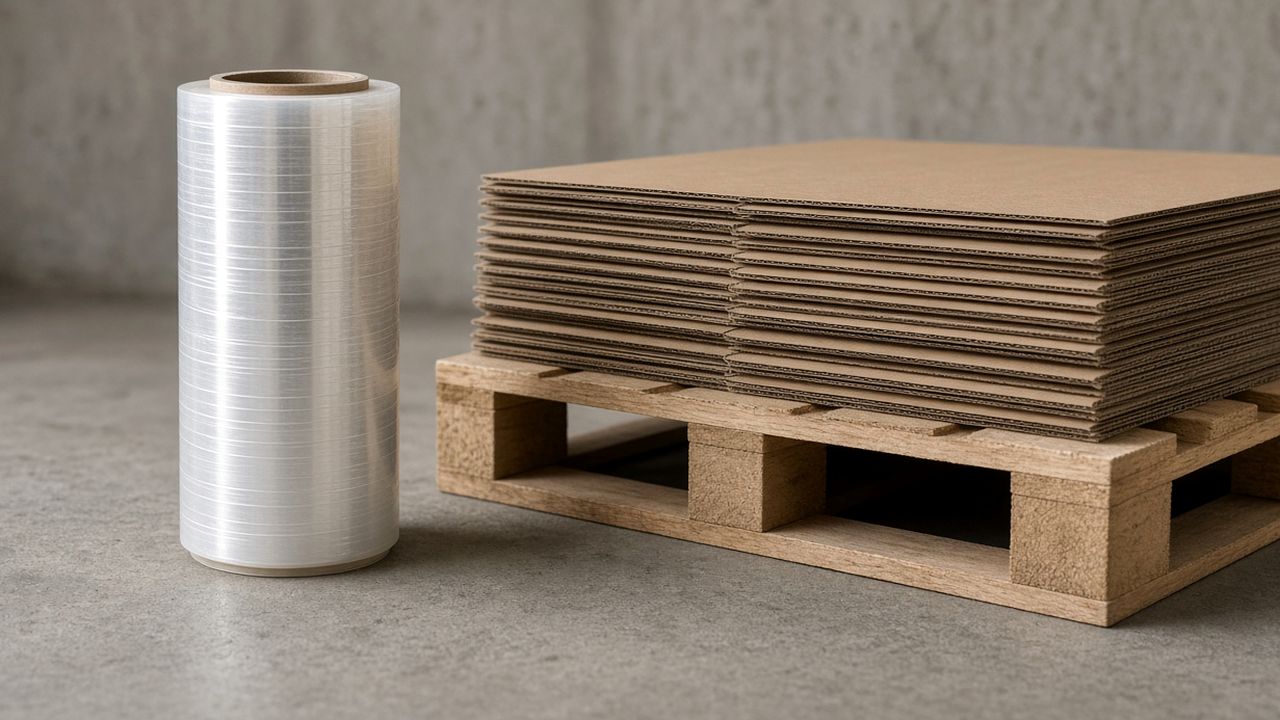
The pad is the sheet between one tier and the next
A layer pad is a flat sheet of corrugated board that sits between the tiers of a pallet. It spreads the weight of the tier above so the goods below are not pressed only on their corners, and it gives the next tier a surface to sit on. Layer pads on this site are also called pallet pads. They are about 2.5 mm, B flute, 125K/T. That is a thin sheet, not a carton and not a thick slab. Cardboard layer pads is the product note, and the range is where the sheet sizes are listed.
The pad does not wrap a product. It does not close a carton. It does not cover a corner. If the pallet is a single tier, you may still want a sheet under the goods or on top of them, but the job people mean by a layer pad is the sheet between tiers. Separating pallet layers is the short version of that job. This guide is how the sheet, the count and the corner guards fit together.
Count the gaps, not the tiers alone
A pallet of four tiers of cartons has three gaps between those tiers. That is three pads, if every gap gets a sheet. A sheet under the first tier, on the pallet itself, is an extra if you use one. A sheet on the very top, under the stretch wrap, is another extra if you use one. People under-order when they count tiers and order that many pads, and they over-order when they count every carton. Counting pads for a pallet writes the count out. The number of pallets you build in a week, times the pads on one pallet, is the reorder.
The sheet has to cover the footprint of the tier. A pad that is smaller than the cartons leaves the outer cartons unsupported. A pad that is far larger wastes board and can catch on racking. Take the size from the pallet you actually build, then match it to a size in the range, rather than cutting a story about an average pallet. We do not publish a single “standard pallet pad” that fits every footprint. The category is the list.
What the pad does not do
Kraft paper at 88 gsm wraps. It is not 2.5 mm board, and it will not spread the weight of a tier. Corrugated paper on a roll is a wrap as well. Corrugated paper sits beside the pads because a warehouse often uses both, not because one replaces the other. Jiffy foam is a soft cushion for glass, crockery and electronics. Foam wrap does not keep a tier of cartons level. Polystyrene sheet, EPS, is a rigid board of a different material. Polystyrene sheets are listed separately. Sheets that sit with a layer pad is the guide that keeps those neighbours in their own jobs.
A carton is not a pad either. Standing small cartons in a gap, or folding a flattened carton between tiers, is a makeshift. It can be uneven, and it is not the B flute sheet the range is. If you have been doing that because the pads ran out, the fix is to put the pad on the reorder, not to rename the carton.
Corners are a different product
Edge and corner protection covers the edges and corners of items, pallets and furniture. The range lists cardboard edge guards, Jiffy foam edge guards, Jiffy foam corner protectors and polystyrene corner protectors. A layer pad does not wrap a corner. A guard does not separate a tier. A pallet that needs both should have both on the order. Edge guards for a pallet and edge and corner protection are that line.
Fit the guard to the corner you are protecting. A cardboard edge guard and a foam corner protector are not the same piece. The cardboard guard is the stiff edge. The foam piece is the soft corner. Polystyrene corners are the rigid moulded alternative. Putting a pad on the corner, folded, does not make it a guard. Order the guard in the length and the profile the range lists, and order enough for the corners you actually strike. Four corners on one pallet is the obvious count. A tall load may want edges as well as corners.
Build the pallet in an order
Put the first tier on the pallet, square to the footprint. Lay a pad over that tier so the sheet supports the cartons that will sit above, including the outer ones. Build the next tier on the pad, then repeat. Guards go on the corners you need protected, typically once the load is high enough to strike a door or a rack, and before the stretch wrap if the wrap would otherwise be the only thing on that corner. Stretch wrap holds the finished pallet. It is not the pad, and it is not the guard. A warehouse that only wraps, and never pads, will see crushed corners on the lower tier.
Do not build the whole pallet and then try to slide pads in afterwards. The sheet has to be there before the weight above it. If a tier is mixed heights, the pad cannot make an uneven surface flat. Fix the tier, then pad it. A pallet built in layers collects the shorter notes on this build.
Getting the sheets here before the pallet is built
Pads are flat, and a week’s pads take less room than a week’s cartons, which is why they are easy to forget until the pallet is half built. Order them with the guards if you use both. Orders placed by 3pm are dispatched the same day. The terms aim for 5.30pm the next working day, and a 1 to 3 day courier is also described, depending on the lines. Friday aims for Monday. A bank holiday on Friday or Monday moves that delivery. UK delivery is free over £50 ex VAT.
TradePro, for trade businesses, starts at 5% off and goes up to 10% when spend is over £1,000 a month. It adds BACS. It does not change the sheet. Reorder the size that matched the footprint, in the quantity the gap-count gives you, and keep the edge guards as their own line so a quiet week of pallets does not silently run you out of corners.