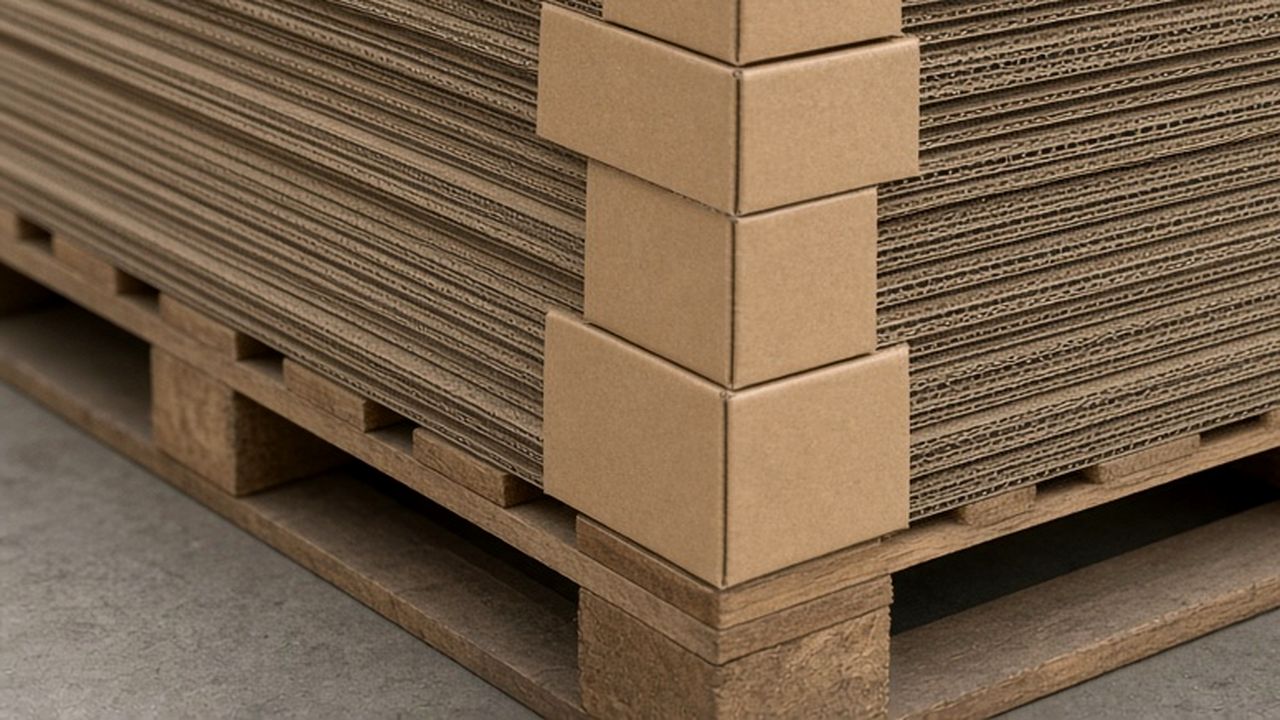
The number that matters is the gaps
A layer pad sits in the gap between two tiers. Four tiers of cartons give three gaps, and three pads, if every gap gets a sheet and you add nothing else. Five tiers give four pads. One tier gives no between-pad at all. Ordering “one pad per tier” over-orders on every pallet. Ordering “one pad per pallet” under-orders as soon as the pallet is more than two tiers high. Pads between the tiers is the build. A pad between pallet layers is the short product note. This is the count.
Write it as a sentence before you turn it into a purchase: “We put a sheet in every gap, and we do not put one under the goods or on top.” Or: “We put a sheet under the first tier, one in every gap, and one on top under the wrap.” Those are different numbers. A pallet of four tiers is three pads in the first sentence and five in the second. Both can be right. They must not be confused in the reorder.
The sheet is about 2.5 mm, B flute, 125K/T. It is thin. Do not “allow extra pads for thickness” as if the board ate into the pallet height in a way that changes the count. The count changes when you add or remove a tier, or when you change your mind about the top and bottom sheets. Cardboard layer pads lists the sizes. Match the footprint, then apply the count.
Multiply by the pallets, then subtract the shelf
If you build twenty of those pallets in a week, and each wants three pads, the week is sixty pads, minus whatever is already on the shelf, plus a reserve that covers the delivery spread. That reserve is a few pallets’ worth, not a second month, unless you have a reason to hold stock. Separating pallet layers reminds you the pad is only the separator. The multiplication is still just pallets times pads per pallet.
Different footprints are different sizes, and they do not share a count even if the tier count is the same. A half pallet and a full pallet may both have three gaps and still be two product lines. Add them separately. A single total of “sixty sheets” with mixed sizes will be picked as sixty of whichever size is easiest to reach.
Edge guards are not in this number. Four corners are four guards, or more if you protect vertical edges as well. Edge guards is a second line on the same order if you use them. Do not convert a pad shortage into “we’ll fold the sheet over the corner”. A pallet built in layers keeps the two counts side by side.
Where the count goes wrong
The count goes wrong when a pallet is not the same every day. If Tuesday’s load is three tiers and Thursday’s is five, an average of four will be wrong on both days. Count the common build, and keep a small extra of the same size for the taller days. If the taller day is a different footprint, it is a different size, not an extra of the common one.
The count goes wrong when damaged sheets are still in the pile. A crushed or torn pad does not spread a tier. Take it out of the number you think you have. The count goes wrong when someone uses a pad as a slip sheet for a single carton on a bench and the pallet pile shrinks invisibly. If pads are walking off to other jobs, either stop that or add it to the number. Kraft, foam and corrugated paper are the other sheets. They are not a secret supply of pads.
The count goes wrong when the reorder is placed by the pallet quantity of goods and nobody has said how many tiers that quantity becomes. A hundred cartons can be ten pallets of one tier or four pallets of several tiers. Ask how the pallets are built. The carton quantity does not contain the pad quantity.
Place the number in time
Orders placed by 3pm are dispatched the same day. The aim is 5.30pm the next working day, and a 1 to 3 day courier is also described. A week that starts Monday needs the pads before Monday if the shelf is already at the last pallet. Friday’s order aims for Monday. A bank holiday on Friday or Monday moves the delivery. Build that into the reserve, or place the order earlier in the week. UK delivery is free over £50 ex VAT.
TradePro, for trade businesses, starts at 5% and goes to 10% over £1,000 a month. The pad count is often a small line next to cartons or tape. It still belongs on the order every time the shelf says so. A discounted month that forgot the pads is a month of crushed lower tiers. Stocked sheets can be returned within 14 days if the size was wrong. Call and arrange it. A wrong footprint is worth returning. A correct footprint you over-counted is a lesson for the next multiplication, and only a return if you have not creased the sheets and the timing still allows it.
Write the sentence, the pads per pallet, and the pallets per week on the same note as the size. When the build changes, change the sentence first. The purchase order is the last thing to edit. Cardboard layer pads stays the product description. The number next to it is yours.
Recount when the goods change shape, not only when the quantity changes. A carton that is taller by one size can take a tier off the pallet and remove a gap, which removes a pad, even though you are shipping the same number of products. The sentence on the note is what catches that. A standing order that never looks up at the pallet will keep buying last year’s gaps. Look up once when the goods change, and the number will follow.